
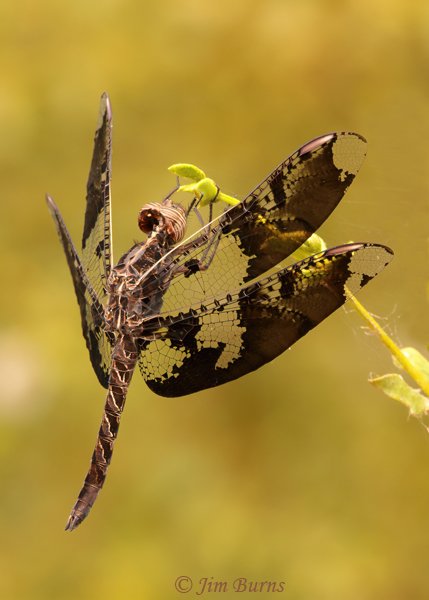
Filigree Skimmer (Pseudoleon superbus) male, Maricopa County, Arizona (July, 2021). Photo: Jim Burns
August Species of the Month
Filigree Skimmer (Pseudoleon superbus)
Our DSA “Species of the Month” for August is the Filigree Skimmer (Pseudoleon superbus). “A Field Guide to the Damselflies & Dragonflies of Arizona and Sonora tells us that it is 36-44mm in length (1.4-1.7 inches), and “wary” and “evasive.” The Filigree Skimmer is often found in canyons and arid regions. Their range includes the southwest United States into Mexico and Central America. Join naturalist and photographer Jim Burns as he sees this species for the first time this calendar year—and remembers why dragonfly chasing is so much fun.
Fascinated by Filgrees
In a universe where common names for our odonata like dragonhunter and shadowdamsel are sure to pique the curiosity of the uninitiated, our most common and colorful skimmers may not even warrant a second glance from jaded enthusiasts. There is one skimmer, though, that belies this narrative. This spring served to show me that special odonate species I needed to yank me back into dragonfly mode after a bugless winter of birding.
It was mid-April, and I was at Papago Park near Phoenix and Tempe in Maricopa County, Arizona, my local patch ten minutes from home. Birding was slow. I was photographing wrestling round-tailed ground squirrel kits as eight a.m. temperatures nudged 90 degrees and birding was slow.
Suddenly, I noticed a large dark insect buzzing along the ground around nearby Creosote bushes. I dismissed it as a beetle or Carpenter Bee. When it would land only ten yards out on ground covered with gravel sized rocks, I could not find it with my binoculars. Exasperated, I finally began taking rock shots all over the bug’s vicinity with my telephoto lens.
In his book “Dragonflies and Damselflies of the West,” Dennis Paulson does describe Filigree Skimmer as “superbly camouflaged,” but when I finally found it on the camera’s LCD screen and realized what I had—a female Filigree (Pseudoleon superbus)— I was blown away.
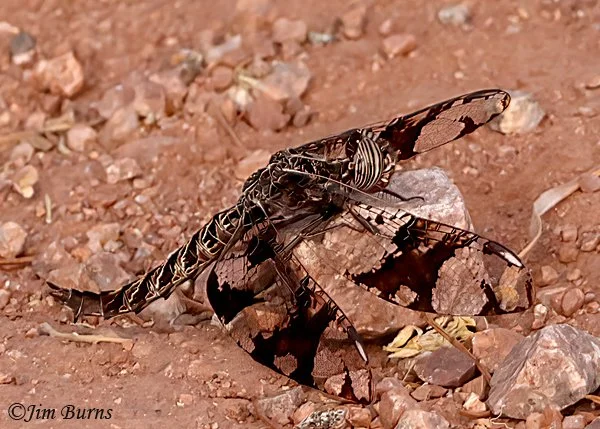
Filigree Skimmer (Pseudoleon superbus) female, Maricopa County, Arizona (April 2026). Photo: Jim Burns
Pierre Deviche, in his encyclopedic website on Arizona Dragonflies does list Filigree Skimmer for Papago Park, but I visit this arid city park at least once a week and had never encountered the species there. The park has three fishing ponds and a small canal, but all the reeds had been deemed invasive species and dredged out a couple years prior, essentially ruining the area for dragonflies.
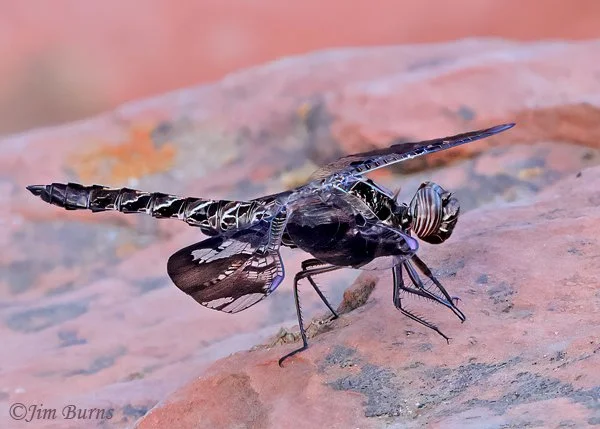
Filigree Skimmer (Pseudoleon superbus) male, Yavapai County, Arizona (July 2023). Photo: Jim Burns
Unlike most skimmer species whose males rock the vibrant colors, the female Filigree is the one Paulson notes as “indescribably variegated.” My April lady was not flat on the ground as expected, but rather draped over her small rock, thorax and forewings on the rock, abdomen and hindwings hanging at 45 degrees, abdomen tip curled up with the last three segments lying flat on the substrate.
“Filigree,” from the Latin filum for thread and granum for grain or small bead, is typically used to describe intricate patterns of gold or silver soldered onto metal jewelry. The male Filigree is basically black with black wing bands, but the female combines fine white lines on her dark brown abdomen and clear lacy wings with black patches and ivory stigmas. Both genders’ outrageous dark eyes sport ivory banding. In their “Field Guide to Dragonflies and Damselflies of Arizona,” Rich Bailowitz and Doug Danforth call it “extraordinarily marked.”
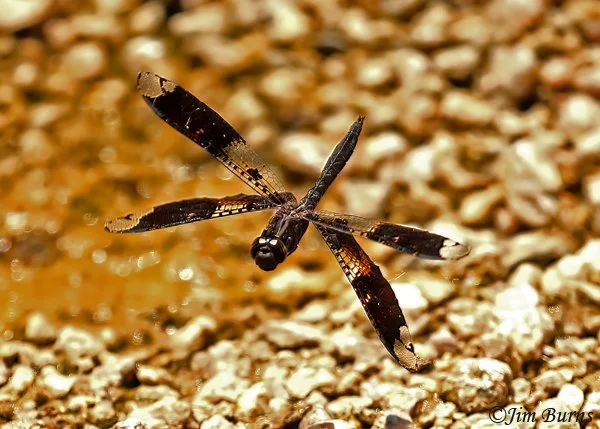
Filigree Skimmer (Pseudoleon superbus) male, Maricopa County, Arizona (June 2019). Photo: Jim Burns
This species’ behavior and lifestyle are as unique as its coloration. In its own monotypic genus (only one species), Filigree Skimmers are usually found in rocky canyons with or without water. They typically fly in the heat of the day and perch on rocks, their wings flat and pressed downward toward or on the perching surface.
Occasionally, they can be seen obelisking or hanging in vegetation. Often they are found resting on roads or trails; the protective, variegated coloration of their bodies and flattened wings keeping them unobserved until almost stepped upon. And good luck seeing one flying against a mottled background!
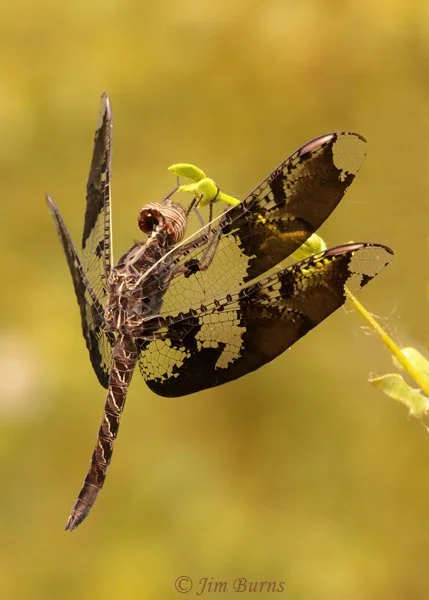
Filigree Skimmer (Pseudoleon superbus) male, Maricopa County, Arizona (July 2021). Photo: Jim Burns
Because Filigree Skimmers are not common—and with their superb camouflage are often overlooked—finding one perched can seem akin to coming upon a piece of the beautiful, fancy jewelry for which they are named, certainly as eye-catching as the brightest male Flame Skimmer (Libellula saturata) or Neon Skimmer (Libellula croceipennis).
So, yeah, I’m back into dragons now, a very special one having drawn me in again. Its species name, superbus, says it all.
Bio: Jim Burns is an outdoor writer/photographer based in Scottsdale, Arizona. He fell into odonata fifteen years ago by chance when he got bored waiting for Common Black Hawks to return to their nestlings with prey and photographed a nearby male Roseate Skimmer (Orthemis ferruginea) having no idea what it was. As often happens, one thing led to another and he became totally hooked on dragons and damsels.
