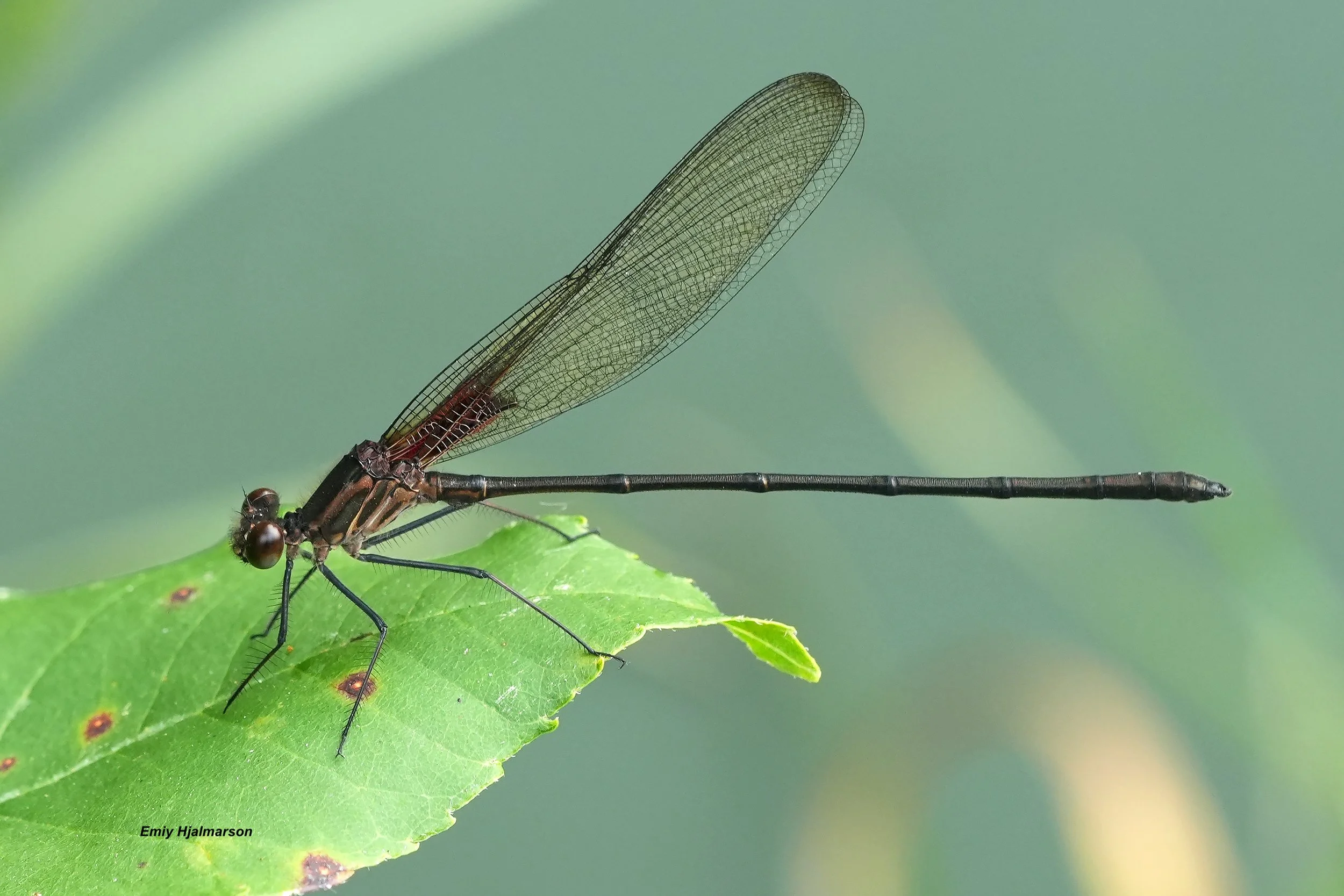
Smoky Rubyspot (Hetaerina titia) male, White River State Natural Area Hwy D Bridge, Berlin, Wisconsin. 9 August 2025. Photo: Emily Hjalmarson.
DSA Species of the Month June 2026
Smoky Rubyspot (Hetaerina titia)
DSA’s Species of the Month for June is the Smoky Rubyspot (Hetaerina titia). This damselfly, in the family Calopterygidae (the broad-winged damselflies), is up to two inches in length, and often found along shaded streams with vegetation. Dennis Paulson, in his Dragonflies and Damselflies of the East, notes that the Smoky Rubyspot’s range stretches south to Costa Rica, and north into the midwestern and eastern United States, including western Oklahoma and Texas. Join naturalist Brett Roberts and Emily Hjalmarson as they encounter this fascinating damselfly in central Wisconsin.
An Unexpected Sighting
The weekend forecast was almost 90°F and muggy, with a high chance of thunderstorms. Since it was the perfect time of year for late-season clubtails to start flying, the potentially disappointing survey conditions didn’t stop us from heading to Green Lake county in central Wisconsin to scour the rivers for Stylurus, the “hanging clubtails”.
As my wife Emily and I arrived, a storm was already rolling in. After seeing only a few meadowhawks, forktails, one Blue-tipped Dancer (Argia tibialis), and a few American Rubyspots (Hetaerina americana), we decided to take one last look at the highway bridge crossing. That’s when we saw something different lurking in the shadows cast by the gathering clouds.
A Smoky Rubyspot! Could it be? August 9th was too early for Smokies to be remotely on our minds, especially this far north. We were 75 miles north of the known populations in the state.
Emily struggled to get an initial “doc shot” while I ran to retrieve the long lens. Of course, with the oncoming storm, we had left that in the safety of the car! After getting better shots, Emily noticed two other perched males. I approached carefully to attempt netting one to ensure our ID was 100 percent solid. Success! We released him after getting our macro photos. He took off for shelter in the riverbank vegetation. Moments later, rain started pelting down, and temperatures plunged from 90°F to 65°F in a matter of minutes. The storms lasted through the next afternoon, and although we were stuck in a coffee shop instead of surveying, we excitedly planned where to look for this species next.
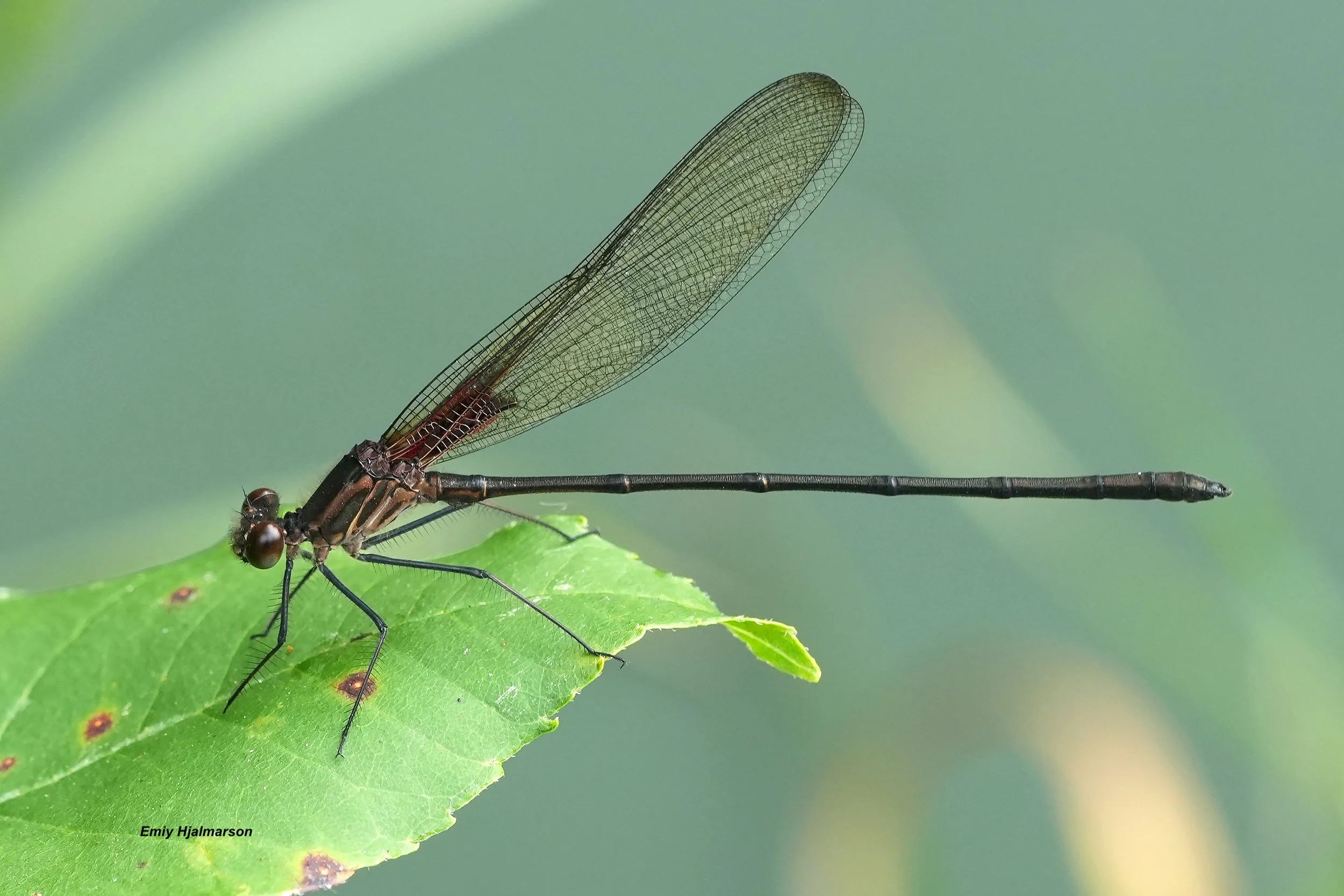
Smoky Rubyspot (Hetaerina titia) male, White River State Natural Area Hwy D Bridge, Berlin, Wisconsin. 9 August 2025. Photo: Emily Hjalmarson.
Wisconsin odonate enthusiasts like us are lucky to have the Department of Natural Resources’ citizen-science database, the Wisconsin Odonata Survey (WOS), for accessing decades of species’ observations submitted by users from across the state. According to WOS, Smoky Rubyspots were previously known from only a handful of sites in southern Wisconsin, with most observations occurring in late August through September. This species can superficially resemble its cousin, the American Rubsypot, especially in Wisconsin where individuals never seem to have the fully dark wings that some do in other parts of the species’ range. Compared to Americans, male Smokies have a darker thorax and dark wingtips, and here they tend to have a smaller patch of red at the base of the wings.
We used aerial photos to select river crossings to search since we are limited to foot surveying, and not many riverside areas are public land. This strategy is hit or miss. Some spots are too high for a good view of the river or lack a safe pull-off spot. We checked counties closer to the original known populations (and closer to home!), but didn’t have success until mid-September. Again, we happened upon them when we were more focused on Stylurus. During this time, two other ode enthusiasts had success in the southern counties, adding two new rivers in three new counties to the list.
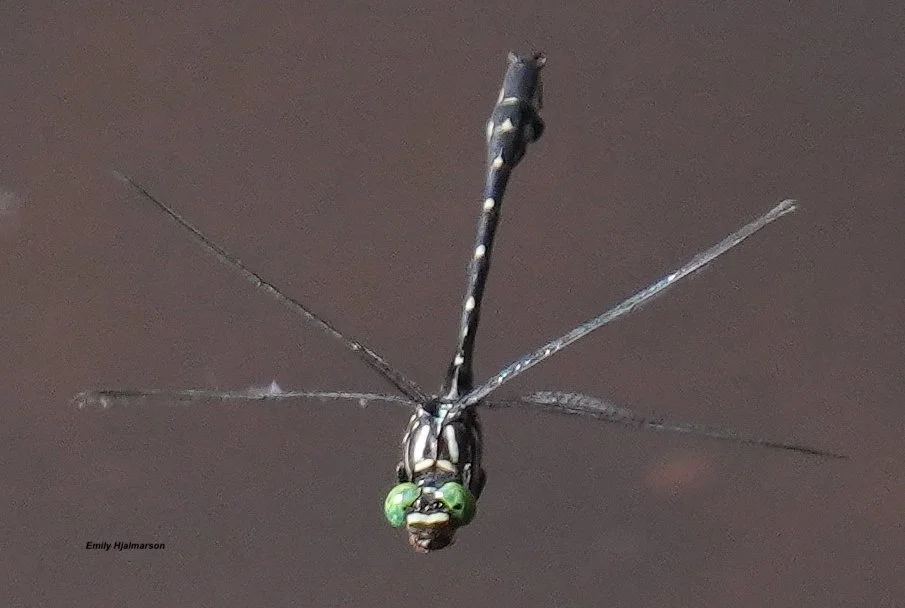
Arrow Clubtail (Stylurus spiniceps), Embarrass River crossing of Cty Hwy I, Clintonville, Wisconsin. 28 September 2025. Photo: Emily Hjalmarson.
A small park in Jefferson County seemed promising since it offered more survey ground than just a highway bridge. Upon arrival, our spirits fell as we saw only a small plastic dock covered in shade with no additional shoreline access. Through the sun-dappling, we saw something flitting its way towards us, landing at our feet on the plastic dock. This time—too close for the long lens—I resorted to iPhone shots of a male Smoky! Emily maneuvered carefully backwards, fully expecting him to disappear into the darkness of the impenetrable forested riverbank, but surprisingly he didn’t budge and she nabbed a higher quality shot.
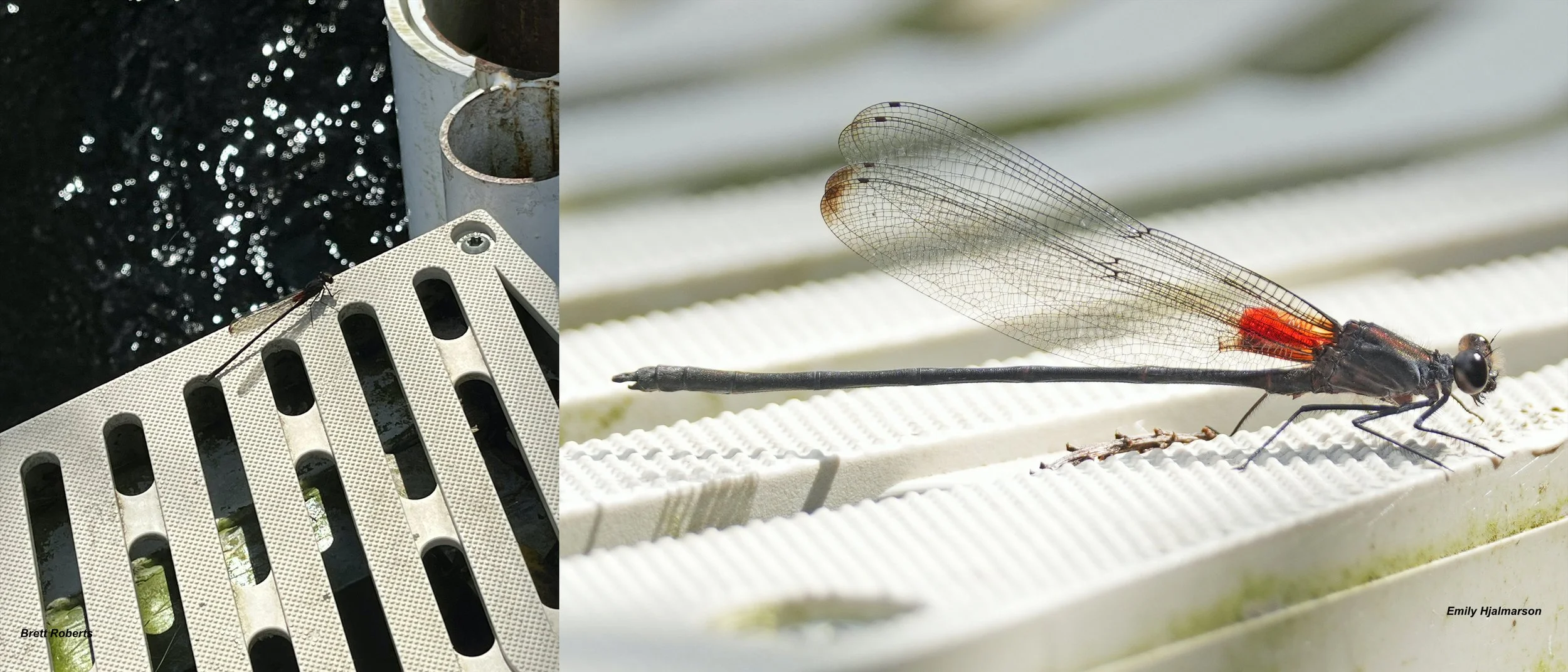
Smoky Rubyspot (Hetaerina titia) male, Bark River Canoe Landing off Cty Hwy E, Sullivan, Wisconsin. 13 September 2025. Photo: Emily Hjalmarson (right), Brett Roberts (left).
A quick look over the guardrail on the other side of the road yielded three more males! Based on what we had observed about this species so far, they seem to like moderate flow rivers/streams with log jams and a mixed covering of sun and shade. Buoyed by our unexpected success, we followed the river into the neighboring county and found a similar park with an almost identical shade-covered plastic dock. This time, we were prepared and approached slowly. The Smokies put on a show, dancing around the dock in tandem pairs. Several Argia species also joined in. We now knew what would occupy our next two weekends. How many more counties could we find them in? How much further north than this would we find them?
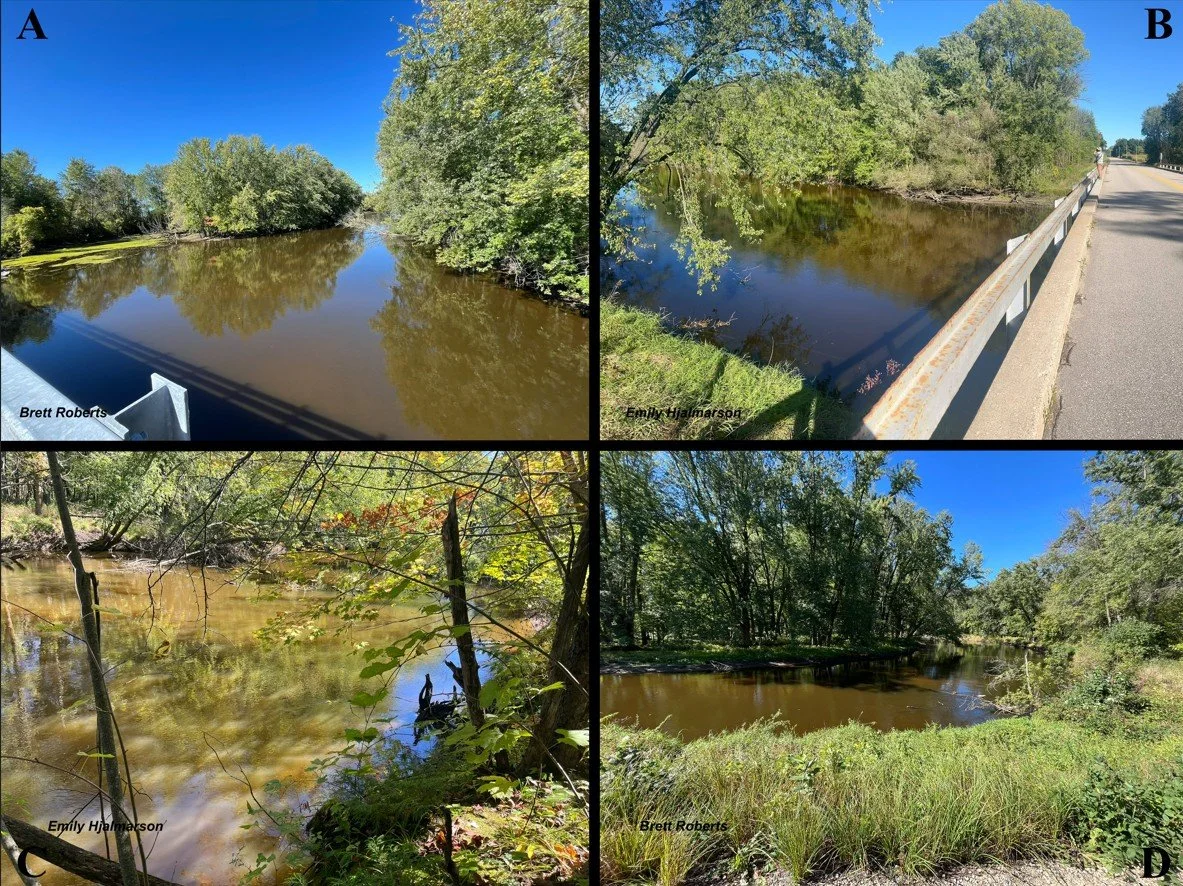
Smoky Rubyspot (Hetaerina titia) habitats on Embarrass River, 28 September 2025. (A) Crossing of Hwy 76, New London, Wisconsin Photo: Brett Roberts. (B) Crossing of Cty Hwy I, Clintonville, Wisconsin. Photo: Emily Hjalmarson. (C) Crossing of Spurr Rd, New London, Wisconsin. Photo: Emily Hjalmarson. (D) Crossing of Cty Hwy F, Bear Creek, Wisconsin. Photo: Brett Roberts.
We stayed south the first weekend and failed, so north we went! We happily relocated them at our initial discovery spot and followed the White River to find a lone male roughly seven miles north as the dragonfly flies, but none at two sites on the same river further north. The next day, we had even loftier aspirations. We drove 40 miles northeast to the Embarrass River, which had several promising-looking crossings. On our second stop, we hit paydirt with 11 males! We kept pushing northwards along the river and found Smoky Rubyspots at three more sites, including females.
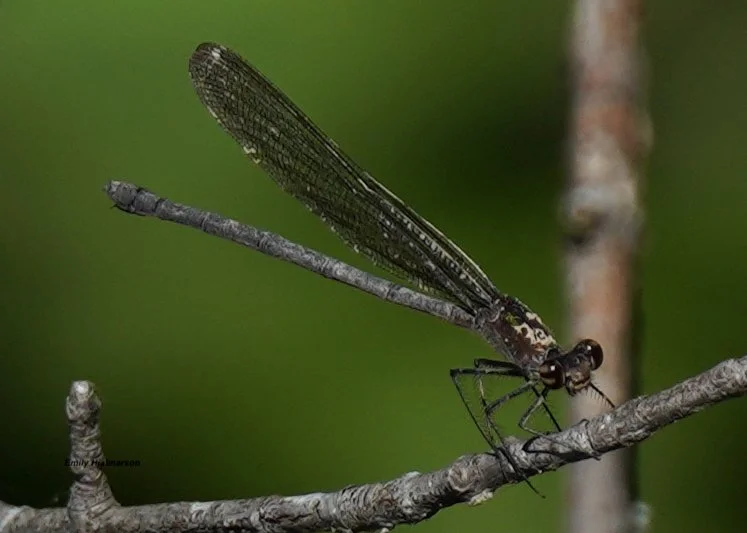
Smoky Rubyspot (Hetaerina titia) female, Embarrass River Crossing of Hwy 76, New London, Wisconsin. 28 September 2025. Photo: Emily Hjalmarson.
Daylight was fading, which put an end to our northerly travels. But–we beat our previous northern record by 51 miles! These observations may represent the new northern limit of this species’ global range according to WOS, iNaturalist, and Odonata Central data.
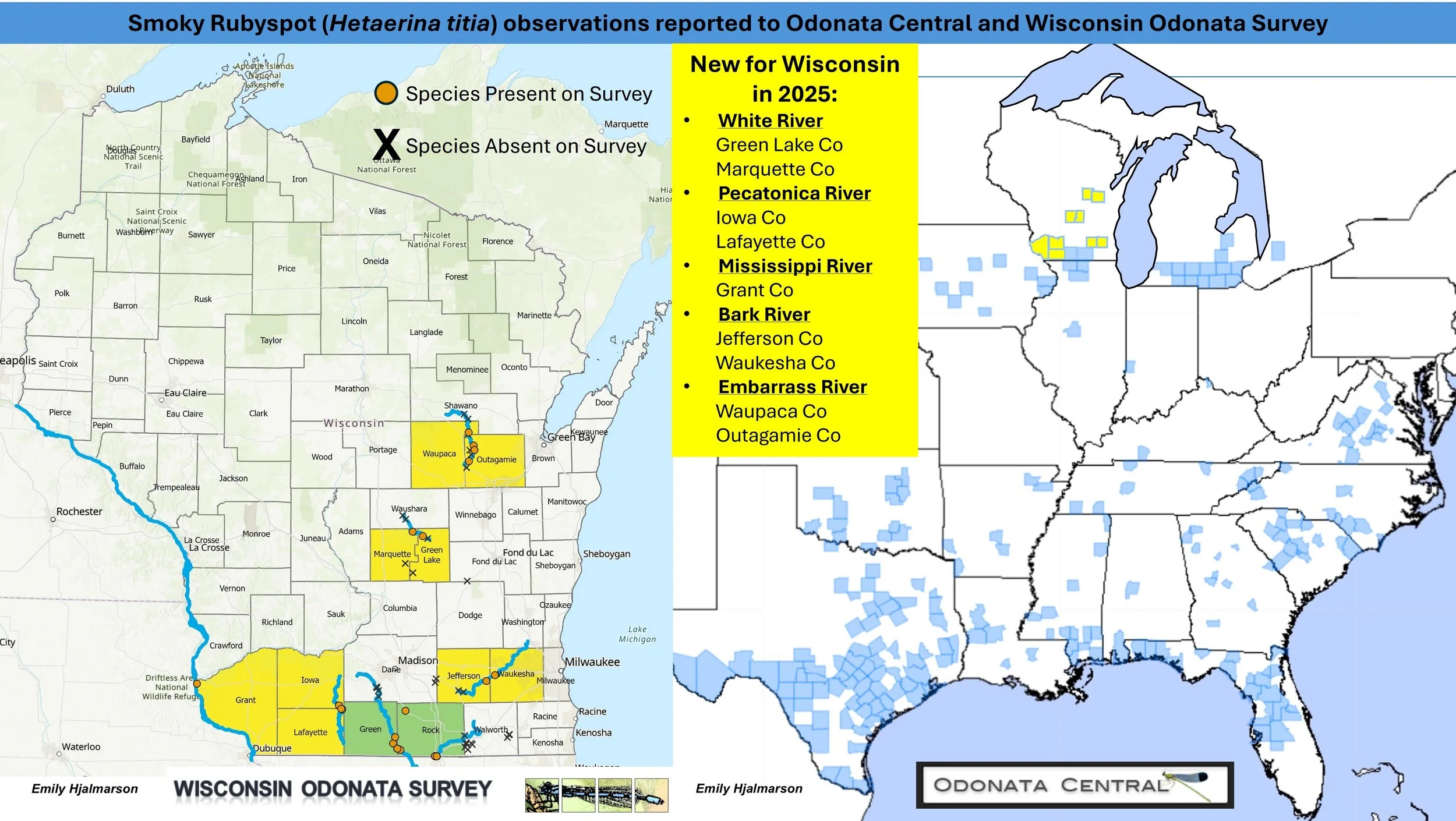
Left panel - Map of Wisconsin Smoky Rubyspot observations new for 2025 (yellow counties) and previous records (green counties). New river systems are shown in blue. Right panel: Range of Smoky Rubyspot in the US from OdonataCentral submissions. Yellow counties are new records for 2025. Figure: Emily Hjalmarson.
Do our new 2025 Wisconsin records represent a colonization push by the species? Maybe most ode enthusiasts had put down their nets by mid/late September, so have other individuals gone unreported? Could Smokies be overlooked as just a plain old American Rubyspot? Or maybe it was just an odd year?
We hope our 2026 flight season surveys can help shed light on these questions.
Brett Roberts and his wife, Emily Hjalmarson, are all-around naturalists and major contributors to the WOS and plan their outings to help expand the understanding of odonate species distribution in Wisconsin. They try to answer questions like: Is a species not reported from a county because it doesn’t exist there or because the county has too few surveys to detect it? If there are no records from the last 10 years, is that because the habitat has changed and the species no longer exists there, or has no one surveyed in the right areas in recent years? They also travel across the United States and internationally with a focus on the natural world, and never pass up the opportunity to document any odonata they may find.
