
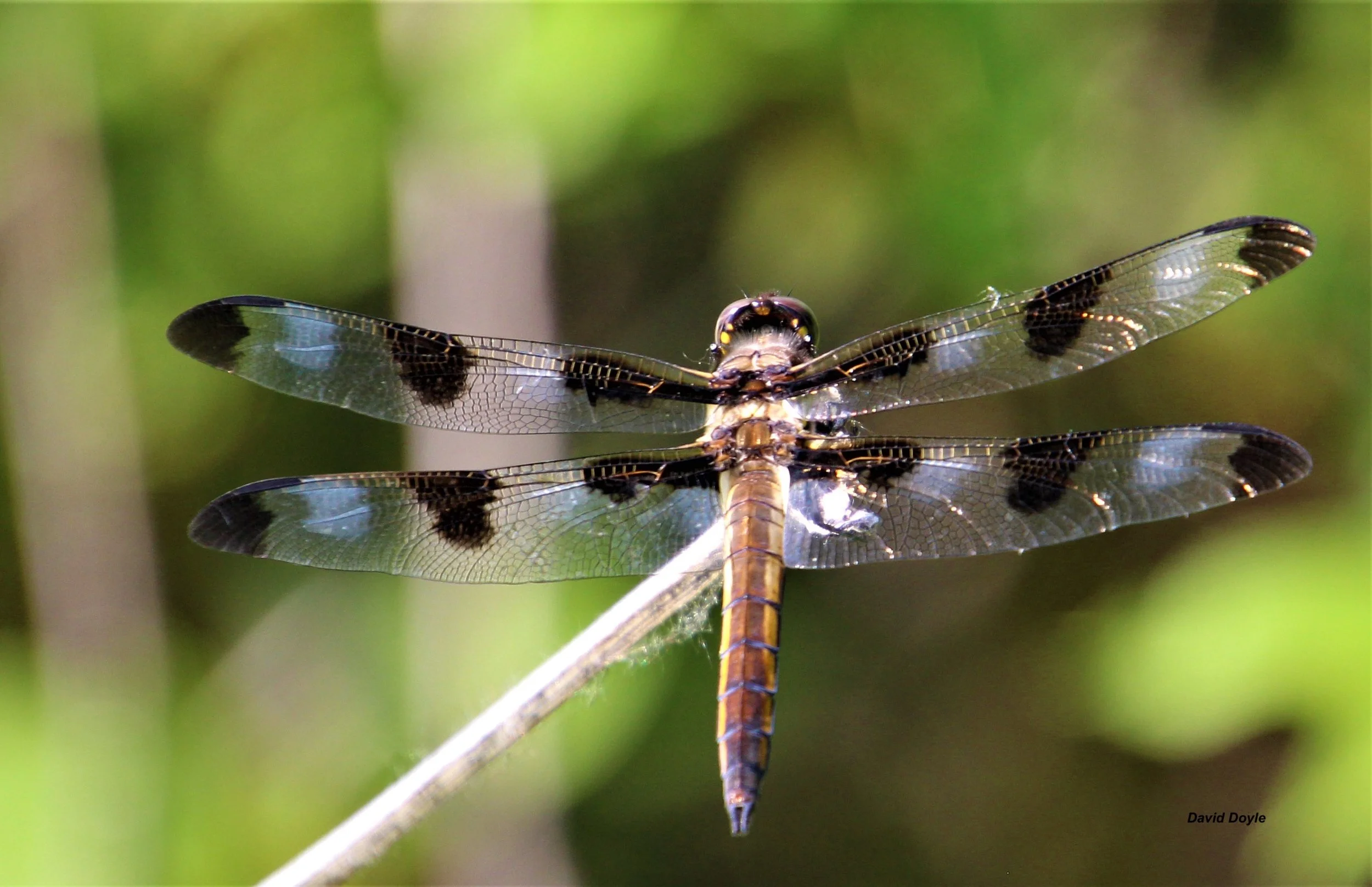
Male Twelve-spotted Skimmer (Libellula pulchella). Bunker Lake Regional Park, Coon Rapids, Minnesota. (10-October 2021). Photo copyright David Doyle.
Dragonfly Society of the Americas’
May “Species of the Month”:
Twelve-spotted Skimmer (Libellula pulchella)
Our May DSA “Species of the Month” is the Twelve-spotted Skimmer (Libellula pulchella) in the family Libellulidae, or “Skimmers”. It is large for a skimmer at 50 mm or about two inches long, and often found in lakes, bogs, ponds, open fields and prairies across much of the United States and southern Canada. Join dragonfly chaser David Doyle as he encounters this delightful species while involved in a Minnesota Odonata survey.
A Perennial Dragonfly Favorite
During the relatively short season in Minnesota, I try to get out every day to hunt for dragonflies. Often, I go with other members of the Minnesota Dragonfly Society, since it helps to have multiple eyes in the search. Often, we are asked to survey a particular property or preserve for odonates. This was the case with Belwin Nature Preserve near Aspen, Minnesota, on a beautiful June day in 2021. Several members and I joined a Belwin volunteer for three hours, searching the area for odonata. We were excited to see what we would find.
When you show up near standing water almost anywhere in North America, one dragonfly will often appear: the Twelve-spotted Skimmer (Libellula pulchella). It can easily be identified from 50 feet away or more. The male has distinctive black and white spotted wings.
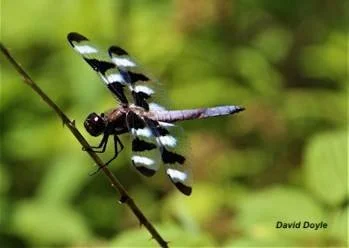
Maturing male Twelve-spotted Skimmer Libellula pulchella. Belwin Nature Preserve, near Afton, Minnesota, (23 June 2021). Photo copyright David Doyle.
The female has the same black wing pattern without the white spots, and she won’t develop the abdominal pruinosity of the mature male. Twelve-spotted Skimmers are usually the largest skimmer (averaging about 2 inches long, or 50 mm) at a pond. This helps make it one of the easier dragonflies to identify.
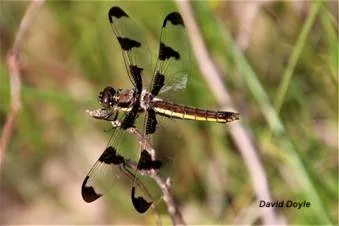
Female Twelve-spotted Skimmer (Libellula pulchella). Ham Lake City Park, Ham Lake, Minnesota (3 June 2021). Photo copyright David Doyle.
This “King Skimmer” is aggressively territorial, and according to Odonate expert Dennis Paulson, it will command a chosen spot of as much as one thousand square feet or 93 square meters. It is easy to overlook or dismiss a dragonfly that is so commonly seen. But what a stunning dragonfly it is! Watching a Twelve-spotted Skimmer glide over the water is guaranteed to capture your attention.
We had a good-sized group that went out together that day. It included Terry Carr, Barry Mullin, Curt Oien, Cathy Perkins, and Dianne Rowse from the Minnesota Dragonfly Society, and Dllona Clendennen, a Belwin volunteer.
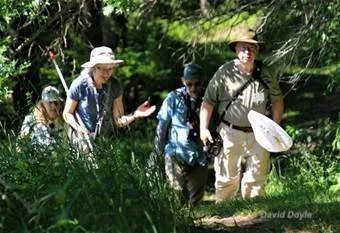
Left to right: Dllona Clendennen, Dianne Rowse, Curt Oien, and Barry Mullin, Belwin Nature Center, near Afton, Minnesota (23 June 23, 2021). Photo copyright David Doyle.
Whenever I am dragonfly hunting, I always hope I will discover a “lifer” insect—or at least one that is rarely found. Such was not to be the case at Belwin Nature Center, as everything our group discovered was a frequently-seen insect.
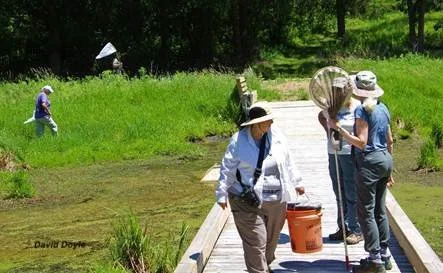
Left to right: Terry Carr, Barry Mullin, Cathy Perkins, Dllona Clendennen, and Dianne Rowse, Belwin Nature Center, near Aspen, Minnesota. (23 June 2021). Photo copyright David Doyle.
But, these species were no less beautiful for being so common. They included Widow Skimmers (Libellula luctuosa), Common Green Darners (Anax junius), and Dot-tailed Whitefaces (Leucorrhinia intacta).
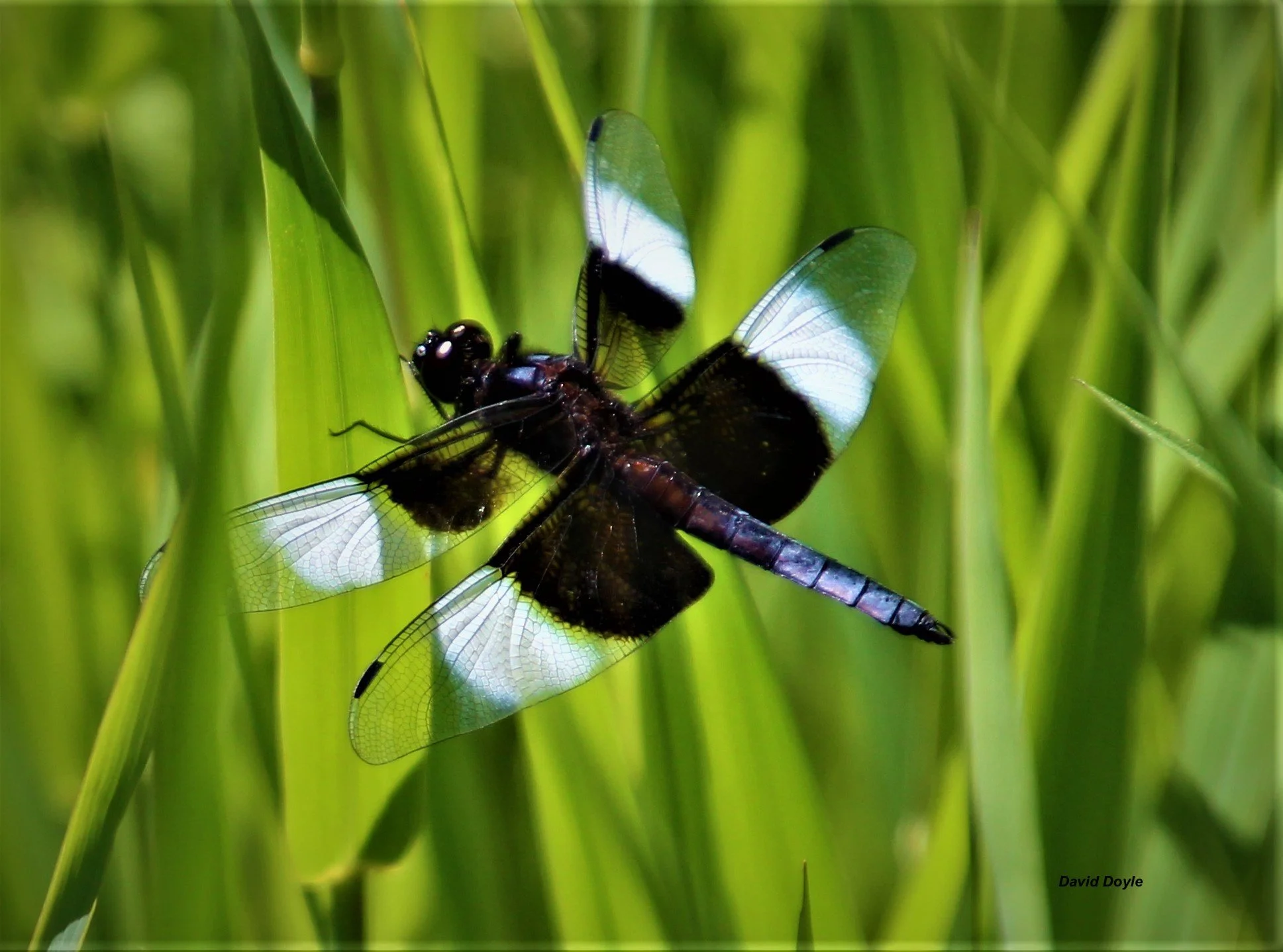
Widow Skimmer (Libellula luctuosa), Belwin Nature Center, near Aspen, Minnesota. (23 June 2021).
I also took a blurry photo of a dying clubtail of undetermined species and an unidentified spreadwing that I failed to get a good photo of.
Oh, well! Such are the joys and disappointments of being a dragonfly chaser.
Bio: This month’s blogger is Dave Doyle, age 79, who has been chasing dragonflies for about 18 years. He’s pretty sure he won’t stop until old age and poor health makes him! His personal photo log includes over 100 species, and he limits himself to looking for odonata within 100 miles of his home.
