
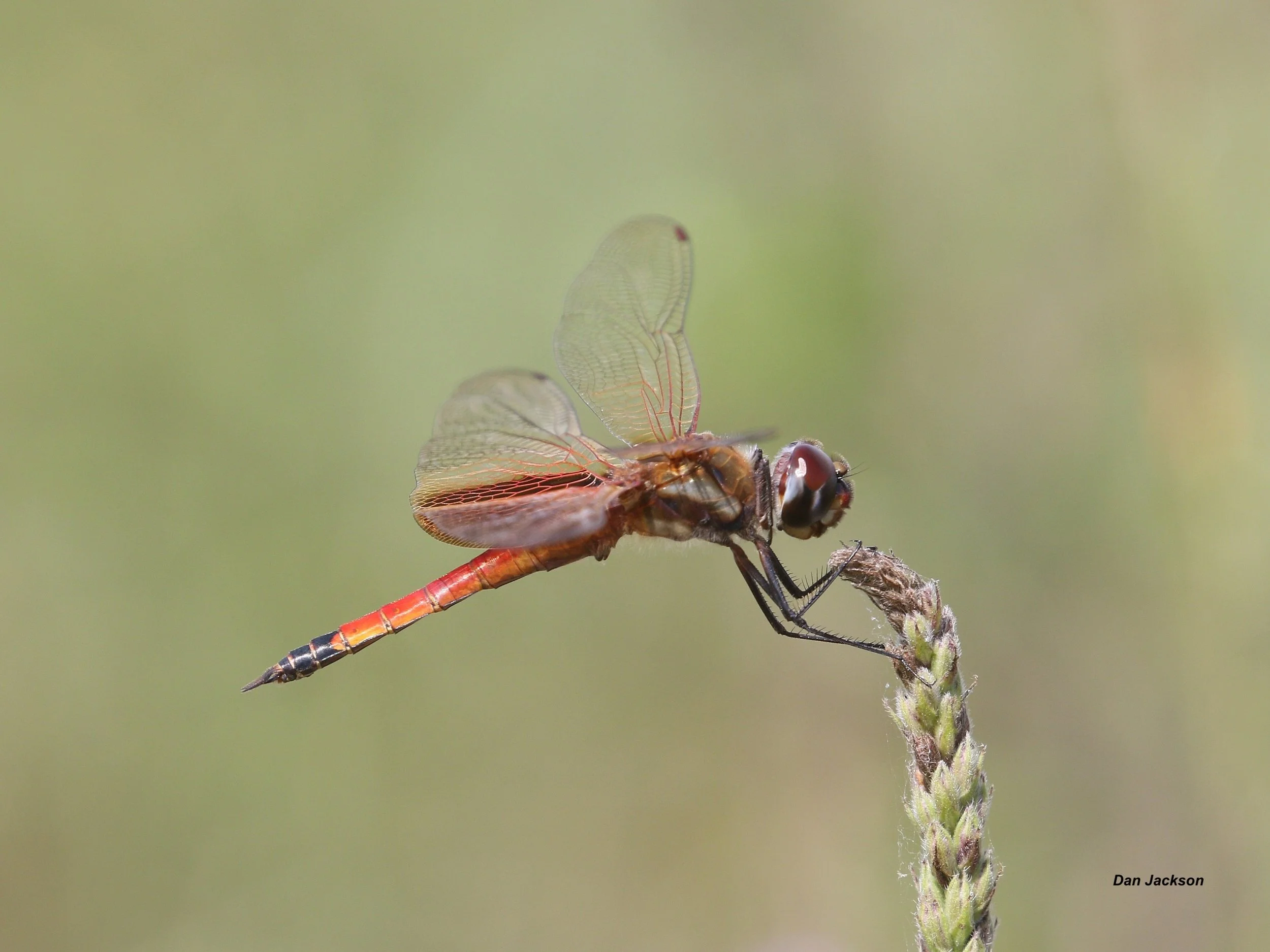
Striped Saddlebags (Tramea darwini) male, La Crosse County, Wisconsin, USA. 27 September 2018. Photo copyright Dan Jackson.
DSA November Species of the Month: Striped Saddlebags (Tramea darwini)
November’s DSA Species of the Month is the Striped Saddlebags (Tramea darwini). This species is in the family Libellulidae (skimmers) and is approximately 45-49 mm in size (1.77-1.93 inches) according to Dennis Paulson's "Dragonflies and Damselflies of the West." Its preferred habitat is shallow ponds with open water and emergent vegetation. The Striped Saddlebags is a migrant species with a core range that extends from northern Argentina to southern Texas. However, the species is also a vagrant that has been recorded as far north as the Upper Peninsula of Michigan in the US, and southeastern Quebec, and northeastern Nova Scotia in Canada. Here, Wisconsin’s Dan Jackson discusses this species’ vagrancy into the Upper Midwest region of the United States and shares some hints on how to recognize this species if it shows up at a pond near you.
A Case of Amazing Vagrancy
My first experiences with Striped Saddlebags (Tramea darwini) occurred in Minnesota and Wisconsin in 2012. On June 21, 2012, while I was surveying Odonata at a location along the banks of the Mississippi River in Winona County, Minnesota, I spotted a “red” Saddlebags perched on a dead twig on the top of a short bush. When I approached, it flew down and landed close to me. With a closer look, I immediately noticed it had very narrow saddles and an obvious stripe on the side of its thorax. It was definitely a species that I didn’t recognize!
I took the opportunity to net the dragonfly to get a better look. I vividly remember my amazement when I looked in Dennis Paulson's "Dragonflies and Damselflies of the East” and identified it as a male Striped Saddlebags.
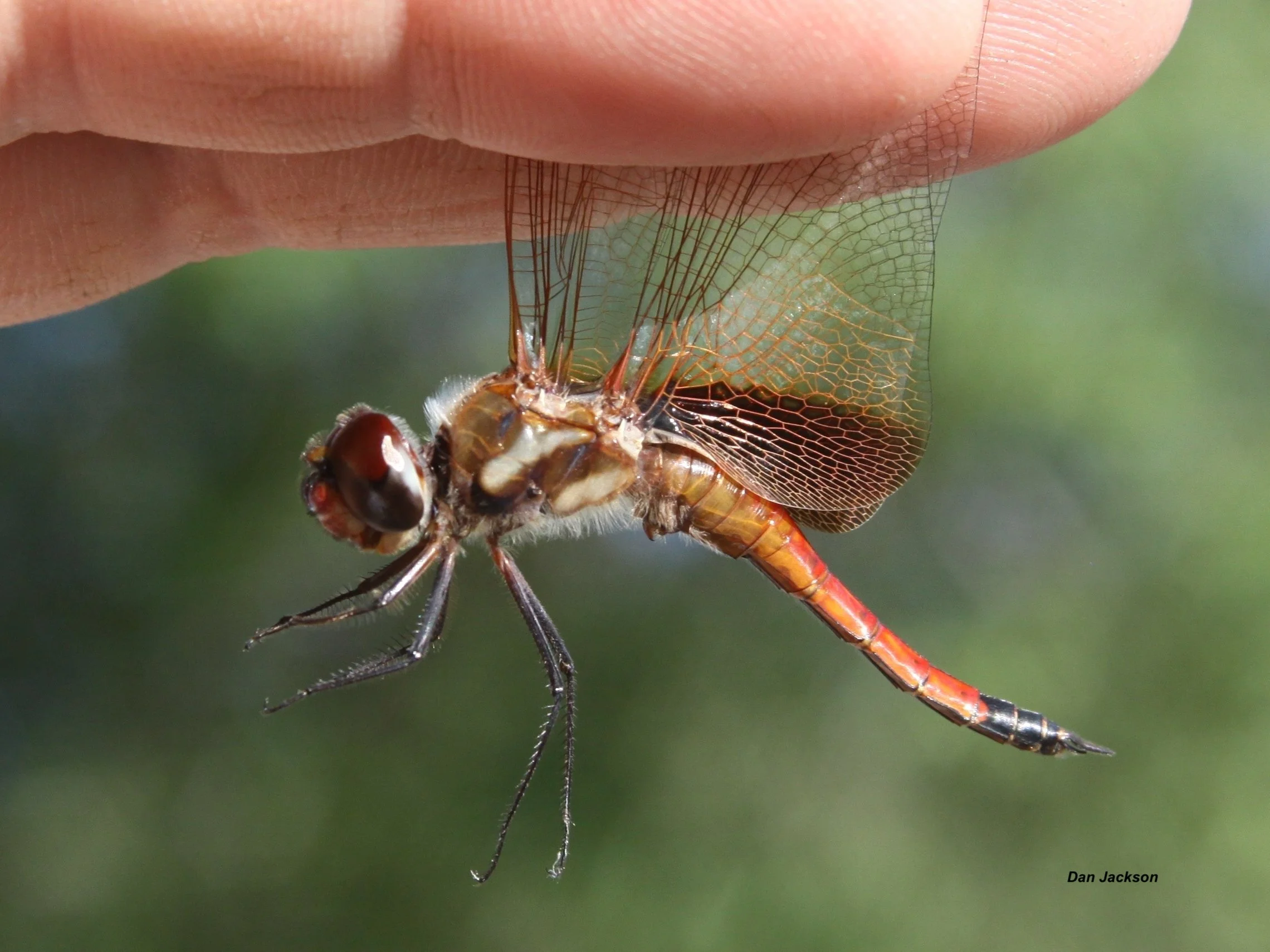
Striped Saddlebags (Tramea darwini) male, Winona County, Minnesota, USA. 12 June 2012. Photo copyright Dan Jackson.
The following day, I was able to photograph another male patrolling over a shallow pond in Houston County, Minnesota about 15 miles farther south. The craziness continued, and I recorded the species on 10 other surveys over the following six weeks. These sightings were spread over five counties in Wisconsin, mostly in or immediately adjacent to the Mississippi River Valley. The species was also recorded by another observer that year in Grant County, Wisconsin, which is also adjacent to the Mississippi.
Since 2012, Striped Saddlebags have been reported in Wisconsin an amazing 44 more times. This included a range of two to nine sightings per year in 2016, 2017, 2018, 2021, and 2025 and and 19 sightings in 2026! Striped Saddlebags have now been reported in 16 of Wisconsin’s 72 Counties including four new counties in 2026. They aren’t seen every year, but when one is found, there are likely more out there.
Vagrant Striped Saddlebags have shown up in most of the states and a few provinces north and east of Colorado. If you take a close look at the map below, you will notice that, just like migrant birds, the north-bound individuals of this species are often found along major rivers and are also concentrated along the Atlantic coast and the shorelines of the Great Lakes. For example, in Wisconsin, about two thirds of the state’s sightings have been reported from the Mississippi River valley.

Striped Saddlebags observation map for species Tramea darwini including iNaturalist Records and excluding Dot Map Records. Copyright John Abbott - Odonata Central.
It is interesting to note that, except for 2012, all of Wisconsin’s reported sightings of Striped Saddlebags have occurred relatively late in the flight season (late July through mid-October). This is also normal for other northern states and provinces. This late flight season and a few other features can be very helpful to those who would like to find them in this region.
Because vagrants of this species are seen relatively late in the flight season, their behavior tends to be different than the other species of Saddlebags that might be encountered at the same time. Black, Red, and Carolina Saddlebags seen in the Midwest and Northeast in the late summer are often tenerals. Teneral Saddlebags perch regularly and tend to perch vertically and relatively low in thick grass. Vagrant Striped Saddlebags tend to be more mature and therefore perch horizontally on the top of weed stalks and even on the tips of dead branches on low trees and bushes. Whenever I see a Saddlebags perched horizontally during the second half of the flight season, I always give it a closer look – it is likely to be Tramea darwini!

Striped Saddlebags (Tramea darwini) female, La Crosse County, Wisconsin, USA. 16 September 2021. Photo copyright Dan Jackson
In flight or perched, the relatively narrow saddles with their very straight outside margin are a key ID feature for this species. In the southern part of the US, as well as Central and South America, there are other Saddlebags and other species with similar markings on the hind wings. In more northerly states and provinces, this feature, along with the solid black abdomen tip shown here are key ID features.
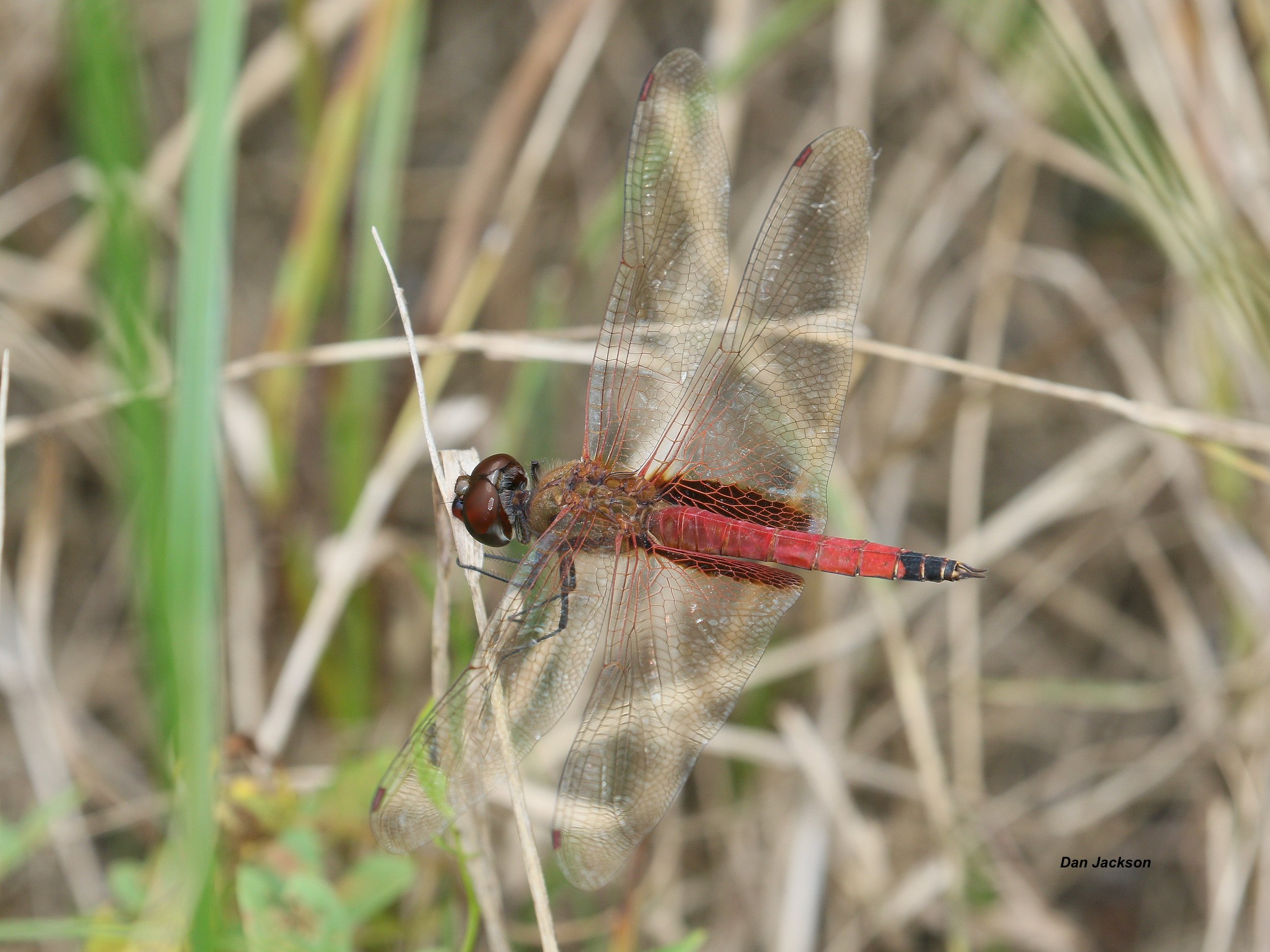
Striped Saddlebags (Tramea darwini) male, La Crosse County, Wisconsin, USA. 2 September 2021. Photo copyright Dan Jackson
Female Striped Saddlebags almost always show the bright white stripe on the side of the thorax for which the species is named. In males, this feature is very obvious in newly-emerged and fresh individuals. However, it tends to fade with maturity and can often be hard to see—but, as shown in the picture below, it is still there.
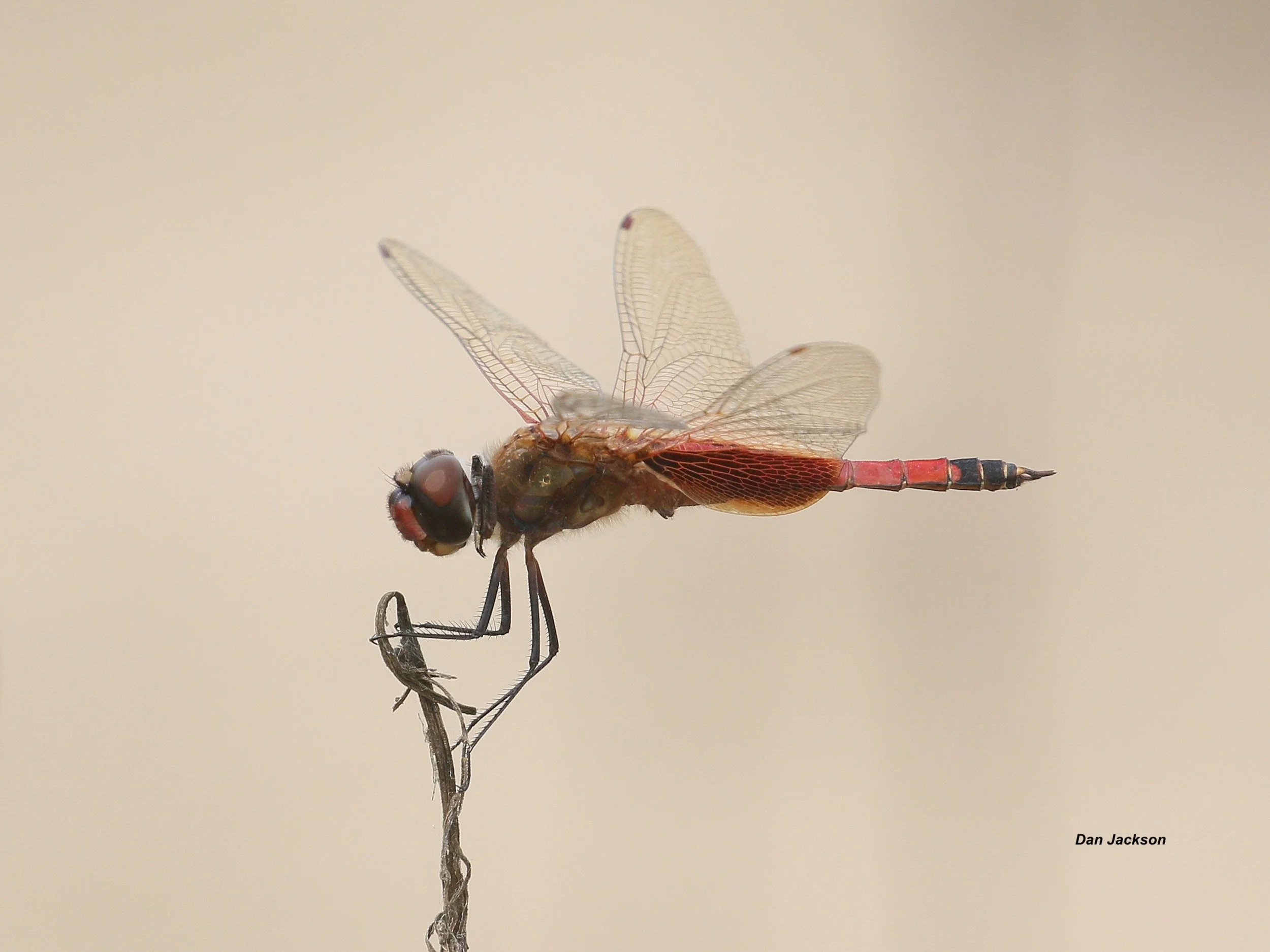
Striped Saddlebags (Tramea darwini) male, La Crosse County, Wisconsin, USA. 2 September 2021. Photo copyright Dan Jackson)
While migrating, this species can often be found with other migrant species including Common Green Darners, Gliders, or other Saddlebags. Pay attention to those swarms late in the flight season in case there is someone special mixed in.
In the far north, males of this species often become territorial when they find shallow open ponds with emergent vegetation along the shoreline. If you see patrolling “red” saddlebags during the second half of the flight season, take a close look at those saddles.
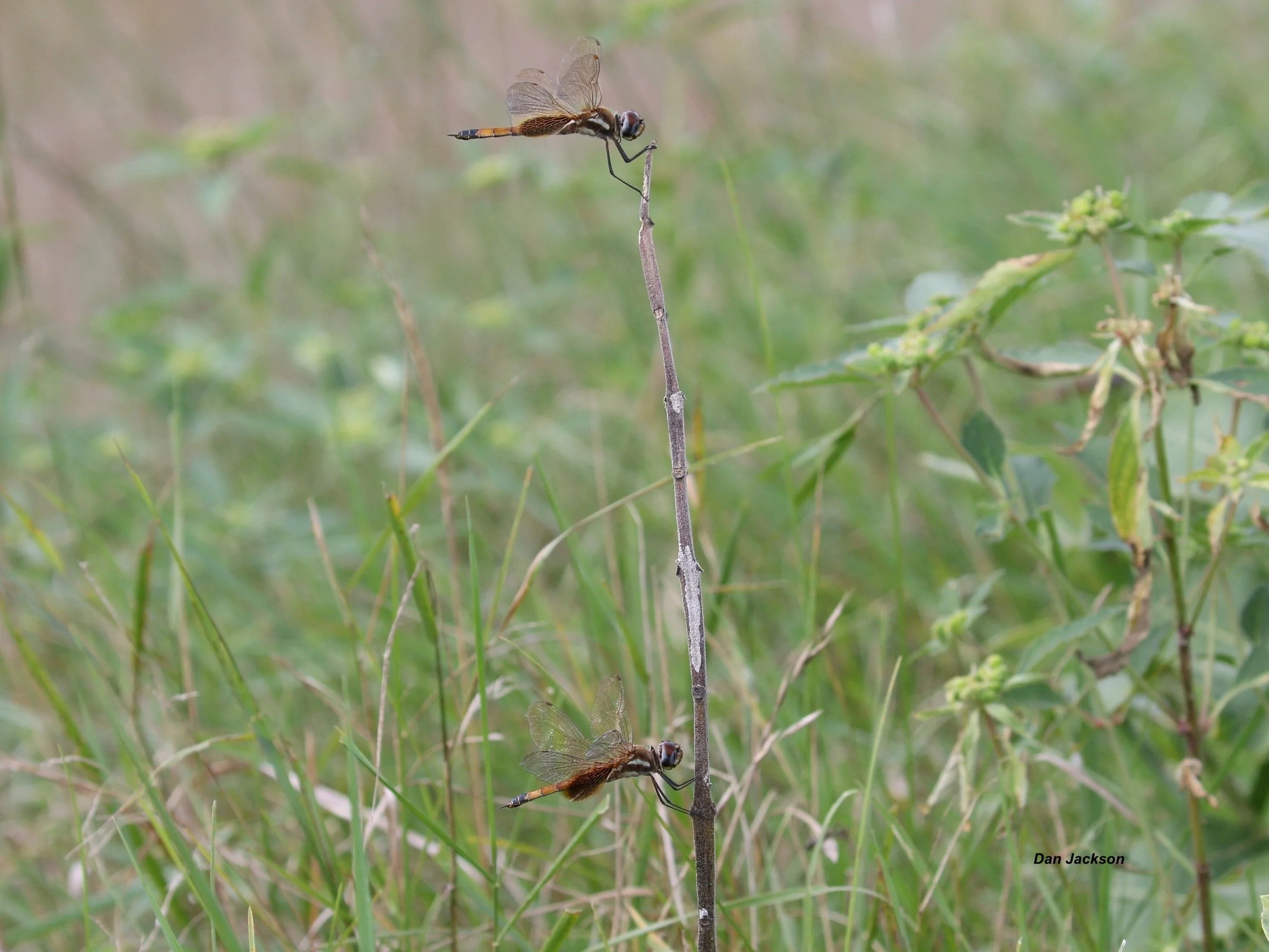
Striped Saddlebags (Tramea darwini) females, La Crosse County, Wisconsin, USA. 8 September 2021. Photo copyright Dan Jackson
Good luck! I hope to see even more sightings of vagrant Striped Saddlebags next year.
Dan Jackson is a native of the Coulee Region of Western Wisconsin with a lifelong passion for nature. He's an avid birder and nature photographer, the record reviewer for the Wisconsin Odonata Survey, and the Wisconsin record reviewer for Odonata Central. He is also the current treasurer and past president of the Wisconsin Dragonfly Society.
